
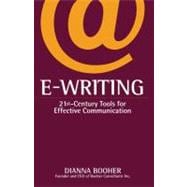
E-Writing 21st-Century Tools for Effective Communication
by Booher, DiannaFormat: Paperback
Pub. Date: 2001-02-01
Publisher(s): Gallery Books
 Other versions by this Author
List Price: $26.24
Buy New
Special Order. We will make every effort to obtain this item but cannot guarantee stock or timing.
$24.99
Rent Book
Select for Price
Used Book
We're Sorry
Sold Out
eBook
We're Sorry
Not Available
How Marketplace Works:
- This item is offered by an independent seller and not shipped from our warehouse
- Item details like edition and cover design may differ from our description; see seller's comments before ordering.
- Sellers much confirm and ship within two business days; otherwise, the order will be cancelled and refunded.
- Marketplace purchases cannot be returned to eCampus.com. Contact the seller directly for inquiries; if no response within two days, contact customer service.
- Additional shipping costs apply to Marketplace purchases. Review shipping costs at checkout.
Summary
Are you guilty of e-mail "trigger finger"? Do you constantly "cc" people you never even see? What are today's rules for conducting business over the Internet? Now,The Elements of Stylemeets "the Miss Manners of memos" in the ultimate writing guide for the digital age.In an era when written communication in the workplace is more crucial than ever, at a time when many professionals all but completely eschew face-to-face dealings,E-writingis poised to become the new bible of business writing. Accessible and inviting, this Web-savvy "how-to" book promises to transform anxious e-mail hacks and mediocre memo writers into eloquent electronic scribes in no time at all.Inside, you will learn how to: combat counterproductive e-mail habitswrite authoritatively and persuasively, with a clear message that generates quick actionhandle e-mail and letter correspondence efficiently and effectivelyselect an appropriate style for the audience you're addressingheighten your professional image, self-confidence, and career prospects.Practicing what she preaches, award-winning communicator and bestselling author Dianna Booher writes in a refreshingly straightforward style and has organizedE-writingto make on-the-spot referencing a snap. Keep it handy; refer to it often -- and your online mailbox will never be the same again.
Author Biography
Dianna Booher is author of thirty-seven books, many of which deal with various aspects of communication. As the founder and CEO of her own training firm, Booher Consultants Inc., Dianna is a respected expert in her field. She works with twenty-five of the fifty largest corporations in America and 227 of the Fortune 500.
Table of Contents
| Introduction: Writing Electronically | 1 | (8) | |||
| PART 1: E-MAIL EXCHANGE | 9 | (38) | |||
|
11 | (4) | |||
|
15 | (8) | |||
|
23 | (6) | |||
|
29 | (4) | |||
|
33 | (7) | |||
|
40 | (3) | |||
|
43 | (4) | |||
| PART 2: THE E-WRITING CULTURE | 47 | (20) | |||
|
49 | (18) | |||
| PART 3: WRITING ON PAPER OR ONLINE | 67 | (66) | |||
|
71 | (6) | |||
|
77 | (3) | |||
|
80 | (46) | |||
|
126 | (7) | |||
| PART 4: STEP 5: EDIT FOR CONTENT AND LAYOUT, GRAMMAR, CLARITY, CONCISENESS, AND STYLE | 133 | (154) | |||
|
138 | (28) | |||
|
166 | (64) | |||
|
230 | (29) | |||
|
259 | (14) | |||
|
273 | (14) | |||
| PART 5: LET'S GET TECHNICAL | 287 | (72) | |||
|
289 | (23) | |||
|
289 | (2) | |||
|
291 | (3) | |||
|
294 | (3) | |||
|
297 | (2) | |||
|
299 | (3) | |||
|
302 | (4) | |||
|
306 | (6) | |||
|
312 | (6) | |||
|
318 | (2) | |||
|
320 | (5) | |||
|
325 | (17) | |||
|
342 | (12) | |||
|
354 | (5) | |||
| A Final Note to the Reader | 359 | (2) | |||
| Bibliography | 361 | (2) | |||
| Appendix A: Grammar Glossary | 363 | (6) | |||
| Appendix B: Answers to Spelling Awareness Exercise | 369 | (2) | |||
| Acknowledgments | 371 | (2) | |||
| Other Resources By Dianna Booher Available from Booher Consultants | 373 | (2) | |||
| For More Information | 375 | (2) | |||
| Index | 377 |
Excerpts
Chapter One: Select the Right Medium to Communicate
We began the last millennium in unity and ended it in isolation. At the turn of the twentieth century, people gathered in town halls to talk politics, went to the theater to watch silent movies, heard news from the same few radio broadcasts, bought gifts and tools at the general store, read about new trends from the same monthly magazines, and studied all subjects in the same classroom.
At the dawn of the twenty-first century, we talk politics in virtual chat rooms, select our movies for home viewing from any of 500 television stations or the corner video-rental shop, buy our gifts and tools from the paper or online catalog, hear our news on television while in the bathroom, read about new trends while in Latvia with our laptop connection to the Internet, and study our online courses at home alone at midnight.
In such a world of emotional disconnection, there's a growing sense of discontent. Customers and coworkers long to be treated as special, important individuals. An automated tracking system that responds to our log-on with "Hi, Bob. Welcome back. The last time you visited, you ordered X" does not exactly leave us with a warm, fuzzy feeling. It has been a long time since having our name inserted in the middle of a direct-marketing letter impressed us.
In an age of impersonal "customization," customers and clients want personal communication. They want a live person to send them an individual e-mail with an answer to their specific question or a suggestion for their specific problem. To confirm the phenomenon, you have only to take a look at your mailbox to see how many chain letters, jokes, and inspirational stories and poems get forwarded to you by friends, coworkers, and customers. These are attempts to say "Let's connect. Let's share a laugh or a tear. Is anybody out there? Do you remember me?"
The e-mail, letter, or proposal writers who can make a positive emotional connection with their writing will win coworkers' and customers' attention, business, goodwill, and loyalty.
Know When to Send an E-Mail, Fax, or Formal Letter or Report
Impact, reference, speed, and distribution are the key criteria. Let's take them one at a time:
Impact:It's an image decision: tux or blue jeans.Protocolmay demand a formal report or letter. When introducing yourself, your product, or your service to a new organization or to a new individual within the organization, most people still expect a formal letter, proposal, or other literature to arrive in hard copy, to be read at their leisure. In other words, if you're writing to the CEO, he or she will generally consider an e-mail a breach of etiquette as a first-time communication from an outsider.
Protocol aside, considerthe look.Prefer to prepare a formal report or letter if the content requires editing and formatting capabilities not available on your e-mail software or that of the reader's.
Finally, consider theformality or informality:Because e-mail is commonly used for routine day-to-day business, the recipient doesn't attach as much importance to an e-mail message as to a formal report, letter, or proposal.
Reference:Will the recipient need to find your information three years from now? With most software programs, you can easily delete all e-mail older than a preset date with a few keystrokes -- or routinely during the archiving process. Although e-mailscanbe kept indefinitely, most users don't bother to make an exception with their file command on a document-by-document basis.
Speed:Yes, you can send a report across town or cross-country by courier in a few hours. But e-mail takes mere seconds. (Of course, when the e-mail may get read is an altogether different matter.)
Distribution:Yes, you can make 50 copies of a 20-page report and distribute it around the building or fax it cross-country. But that's definitely more expensive and more trouble than hitting a few keys. Second, consider the ease of a recipient forwarding your information to others. That's easier done (with you controlling the quality of the "reprint") by e-mail.
Impact, reference, speed, distribution. Consider each in making your decision about which medium to use e-mail for a specific message.
Know When to Phone Instead of Writing E-Mail or Letters
Prefer to phone when:
- You need an immediate response. (You can't guarantee when someone will answer e-mail, but if you catch him or her answering the phone, you may get an immediate response.)
- You want to hear someone's voice tone to "read between the lines" about the message, information, personal commitment, and so forth. People are typically less on guard when speaking than when writing.
- You need to ask questions and negotiate issues, and the answers to the questions determine your immediate direction in the negotiations.
- You are concerned about the privacy of your comments.
Prefer e-mail to the phone when:
- The information is complex and will warrant repeating (rereading).
- A written copy will be more convenient for later reference.
Nothing makes another person as angry about the wrong choice of media as the following situations: 1) when someone leaves a voice mail with detailed information that needs to be transcribed almost in its entirety; or 2) when someone e-mails about a situation that has too many discussion points, requiring either an ongoing saga or an extended, time-consuming response.
Understand the Dangers of E-Mail Misunderstandings and Major Faux Pas
For all its convenience, e-mail has a few drawbacks. Consider them carefully. First, humor doesn't travel well in typical e-mails -- unless authored by skilled comedy writers. In the absence of tone of voice, facial expression, and body language, readers may interpret your flippant or witty remark as literal and stupid.
Second, you risk losing control of what you've written. Yes, others should not forward your sensitive messages without your permission. But they often do. Forwarding other people's e-mail tempts people of even the highest integrity.
Two good questions to ask yourself before putting anything in e-mail: 1) What might happen if this e-mail were forwarded to everyone in the company? 2) What might happen if a client or supplier sued us, and all our e-mail records were subpoenaed for court?
Commit your information and opinions to e-mail accordingly.
Copyright © 2000 by Dianna Booher
Excerpted from E-Writing: 21st-Century Tools for Effective Communication by Dianna Booher
All rights reserved by the original copyright owners. Excerpts are provided for display purposes only and may not be reproduced, reprinted or distributed without the written permission of the publisher.
An electronic version of this book is available through VitalSource.
This book is viewable on PC, Mac, iPhone, iPad, iPod Touch, and most smartphones.
By purchasing, you will be able to view this book online, as well as download it, for the chosen number of days.
Digital License
You are licensing a digital product for a set duration. Durations are set forth in the product description, with "Lifetime" typically meaning five (5) years of online access and permanent download to a supported device. All licenses are non-transferable.
More details can be found here.
A downloadable version of this book is available through the eCampus Reader or compatible Adobe readers.
Applications are available on iOS, Android, PC, Mac, and Windows Mobile platforms.
Please view the compatibility matrix prior to purchase.