
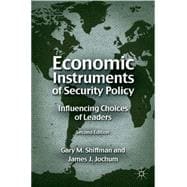
Economic Instruments of Security Policy Influencing Choices of Leaders
by Shiffman, Gary M.; Jochum, James J.Edition: 2nd
Format: Paperback
Pub. Date: 2010-12-15
Publisher(s): Palgrave Macmillan
 Other versions by this Author
List Price: $78.74
Buy New
Usually Ships in 8 - 10 Business Days.
$74.99
Rent Textbook
Select for Price
Rent Digital
$58.50*
Used Textbook
We're Sorry
Sold Out
How Marketplace Works:
- This item is offered by an independent seller and not shipped from our warehouse
- Item details like edition and cover design may differ from our description; see seller's comments before ordering.
- Sellers much confirm and ship within two business days; otherwise, the order will be cancelled and refunded.
- Marketplace purchases cannot be returned to eCampus.com. Contact the seller directly for inquiries; if no response within two days, contact customer service.
- Additional shipping costs apply to Marketplace purchases. Review shipping costs at checkout.
Summary
Economic turmoil has spread throughout the western world, but terrorists and other threats to national security have not been put out of business by the Great Recession. Economic Instruments of Security Policyexplores the critical question: does the United States and its allies still maintain effective economic tools to influence the behavior of those who seek to cause us harm? Governments have at their disposal many economic instruments to promote national security, such as sanctions, foreign aid, international trade, international finance, and laws blocking funds for international terrorism. This book examines the use of theses economic policies and addresses how best to measure their effectiveness.
Author Biography
Gary M. Shiffman is Professor and the Director of Homeland Security Studies at the Center for Peace and Security Studies, School of Foreign Service, at Georgetown University, and Managing Director of the Chertoff Group. He previously managed a corporate business unit as a Senior Vice President and General Manager. He has also served at the U.S. Department of Homeland Security, as Chief of Staff at U.S. Customs and Border Protection, and in the U.S. Senate as a National Security and Senior Policy Adviser. He is a decorated military veteran, having served in policy, planning, and operational positions in the U.S. Department of Defense. James J. Jochum is an Adjunct Professor in the Security Studies Program at Georgetown University and at American University in Washington, D.C. Mr. Jochum was appointed by President Bush as Assistant Secretary of Commerce during which time he led both Export Administration and Import Administration within the U.S. Department of Commerce. He also served as a senior staff member in the U.S. Senate. He is a founding member of the law firm Jochum Shore Trossevin PC.
Table of Contents
Acknowledgments * Forward to the Second Edition * Introduction * PART I: THE INDIVIDUAL * Chapter One: States Don’t Make Decisions; People Do * Adam Smith and Twenty-first Century National Security * Maximizing, Rationality, and the Bounds of Institutions * Experimentation in Economic Science * Chapter Two: The Economics of Autocracies * Some Are Ranchers and Some Are Wolves * Predicting the Dictator: A Theoretical Model * Chapter Three: Principles for Policymakers * PART II: THE WORLD * Chapter Four: Castro’s Cuba and U.S. Sanctions * The Cuban Economy in the 1990s * Dictating Economic Performance * Sanctions: Truth in Advertising * Chapter Five: Democracies and the Politics of Trade * Free Trade Agreements * Case Study: The PRC and Most Favored Nation Status * Case Study: Pistachios, Rugs, and Relationship-Building * Case Study: India and Commerce * Case Study: The PRC, Public Disclosure and Verified End Users * Import Restrictions * Case Study: The PRC and non-market economies * Trade as a Tool: Roundup * Chapter Six: Money and Finance as Security Tools * Money * Inflation * Case Study: Swiss dinars and Saddam dinars * Case Study: Internet Marketplace * Case Study: Money Laundering in Ukraine * Chapter Seven: Exchange Rate Choices and National Security * Choosing an Exchange Rate * Case Study: Dollarization * Choosing Power Over Growth, Again * Chapter Eight: Maximizing Over Time Through Lending and Borrowing * International Finance * Case Study: International Financial Institutions and the East Asian Financial Crisis * Case Study: Tibet vs. the World Bank at Qinghai * Sovereign Lending and Foreign Direct Investment * Debt Dynamics and Debates * Case Study: Debt Forgiveness – Republic of Congo * Case Study: Did the Great Recession Change the Competitive Equation? * Summary: Money, Exchange Regimes, Debt * Chapter Nine: Curing Poverty Helps National Security * Terrorism, Insurgency, and Poverty * Theory of Growth * Incentives and Growth * De-industrialization: When Countries Do Not Invest in Domestic Capacity * Case Study: The Millennium Challenge Account * Case Study: The African Growth and Opportunity Act * Case Study: Saudi Arabian Charities * Case Study: Iraq * Case Study: Syria * Case Study: Law Enforcement Against al Qaeda * Case Study: Brothers to the Rescue and the “Anti-Terrorism Amendment” to the FSIA * Conclusion * Appendix * Endnotes
An electronic version of this book is available through VitalSource.
This book is viewable on PC, Mac, iPhone, iPad, iPod Touch, and most smartphones.
By purchasing, you will be able to view this book online, as well as download it, for the chosen number of days.
Digital License
You are licensing a digital product for a set duration. Durations are set forth in the product description, with "Lifetime" typically meaning five (5) years of online access and permanent download to a supported device. All licenses are non-transferable.
More details can be found here.
A downloadable version of this book is available through the eCampus Reader or compatible Adobe readers.
Applications are available on iOS, Android, PC, Mac, and Windows Mobile platforms.
Please view the compatibility matrix prior to purchase.